
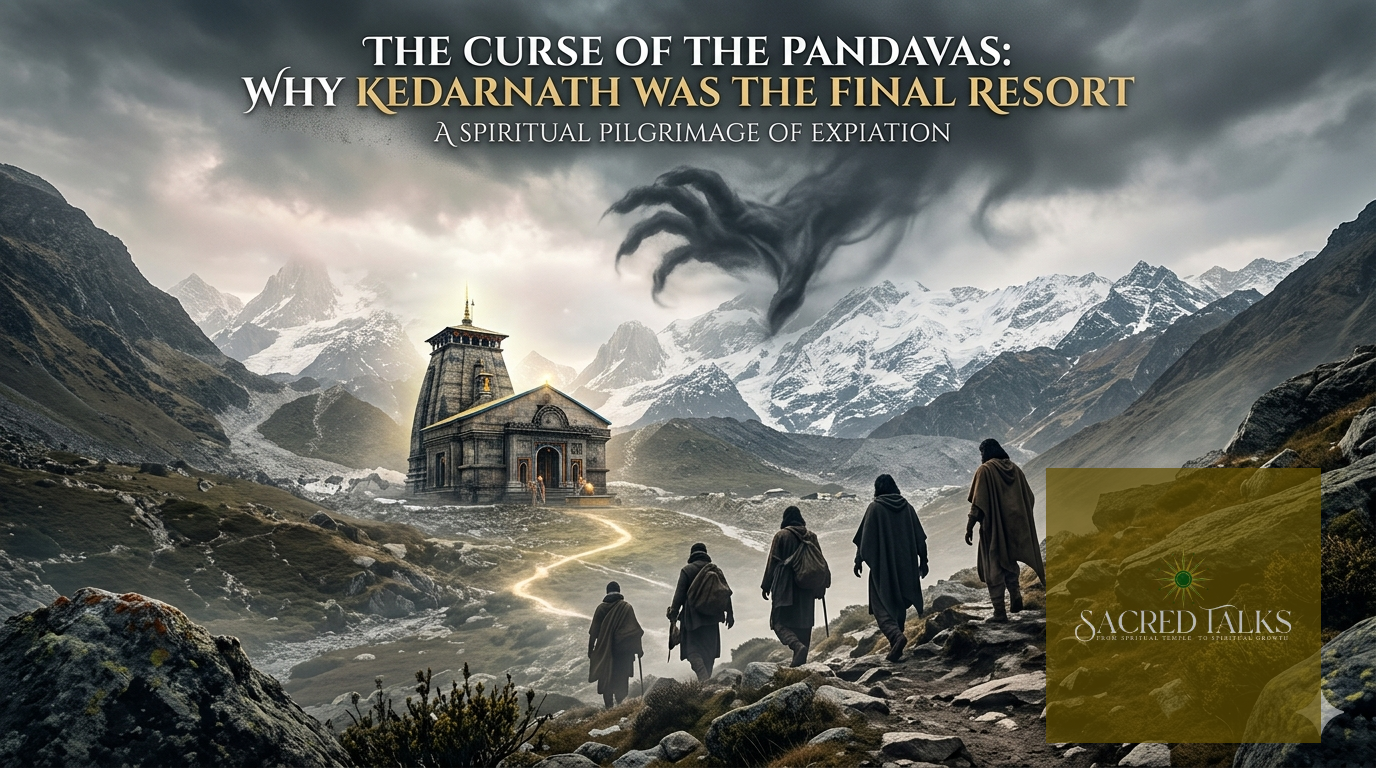
The war was over, but for the Pandavas, the real battle was just beginning with the curse of the pandavas.
The cheering had died down, the throne was finally theirs, and on paper, they were the most powerful men alive. But walk into the palace, and you wouldn’t find a party. You’d find a heavy, gut-wrenching silence that made the air feel like lead.
Behind those golden crowns, the five brothers were falling apart. It wasn’t just “bad vibes” it was the crushing weight of Gotra Hatya and brahma hatya. Think about it: they hadn’t just defeated enemies; they had slaughtered their own mentors, their grandfathers, and their cousins.
They quickly realized a messy, human truth. This is the Mahabharata Aftermath.
Whenever they looked at their hands, they saw the blood of their own family. Their “big win” didn’t feel like a victory at all. It felt like a curse they had to wake up to every single day. It’s a reminder that they had won the world, but lost themselves in the process.
The story of the Curse of Pandavas
Do you know the Kedarnath Temple History? For that you have to understand that for the Pandavas, the crown wasn’t a prize, it was a lead weight. They had won the war, but they were living in a state of “success without peace.”
Here is how their “happily ever after” turned into a high-altitude chase with the curse of the pandavas:
- The Debt They Couldn’t Pay: In the eyes of the universe, they weren’t heroes; they were guilty of Gotra Hatya (killing family) and Brahma Hatya (killing their gurus). That’s a heavy karmic bill to settle, and it cast a massive shadow over their new kingdom.
- The Internal Mess: The brothers realized pretty quickly that you can’t run a country when you’re spiritually broken. Their victory felt less like a win and more like a curse built on the wreckage of their own bloodline.
- The Ultimate Ghosting: Following Rishi Vyasa’s advice, they went looking for Lord Shiva to ask for forgiveness. But Shiva? He wasn’t having it. He was so disgusted by the violence of the war that he literally ghosted them. He didn’t want to see their faces, which forced the brothers to ditch their royal robes and start a grueling trek into the freezing peaks.
- The High-Stakes Hide-and-Seek: The chase went from Kashi all the way to the Himalayas. In the Kedar Valley, Shiva even turned himself into a bull to hide in a herd of cattle.
Kedarnath isn’t just a temple; it’s the finish line of five brothers desperately trying to fix what they broke.
The Divine Ghosting: Chasing a Hidden God
Ever heard of the Pandavas and Lord Shiva story? Desperate to wash away the blood on their hands, the Pandavas went looking for Lord Shiva, hoping for a quick path to absolution. But Shiva wasn’t interested in an easy handshake or a simple ritual. He was genuinely disgusted by the carnage of the war and basically “ghosted” them. He had no desire to be found by men who had just walked off a battlefield, even if they claimed the war was “righteous.”
This rejection forced the world’s most powerful warriors to make a choice. They stripped off their royal silks, walked away from their palace comforts, and started a grueling trek into the freezing, jagged heart of the Himalayas.
The search eventually led them to the Kedar Valley, where Shiva pulled one last disappearing act: he transformed into a bull to hide in the middle of a herd of cattle. It was the ultimate “vibe check.” Could the Pandavas see through the noise of the world to find the divine?
It was Bhima who finally sensed a strange, electric energy coming from one specific bull. Just as he lunged to grab it, Shiva began to dive into the earth to escape. But Bhima was faster- he managed to catch hold of the bull’s hump. That persistent, desperate grip became the physical anchor for the temple.
That’s why the Kedarnath we visit today is centered around that hump. it’s a permanent reminder of a moment when desperation met the divine. Do you know there is bheem shila in Kedarnath? Since then, Panch Kedar Pilgrimage started and now there are total 5 shiva temples.
The “High-Altitude Reset”: Why the Mountains?
Why couldn’t the Pandavas just light a few lamps and pray from the comfort of their palace? Why did they have to climb until their lungs felt like they were on fire?
There’s actually a raw, psychological science behind why their “Final Resort” had to be at 11,755 feet. It wasn’t just a trek; it was a total system overhaul. Here is why the height mattered:
- Starving the Ego: When the air gets that thin, your body doesn’t have the luxury of overthinking. You stop ruminating on the past because your brain is focused entirely on the next breath. Up there, the “Ego” that part of you obsessed with guilt, status, and “who did what” physically starves for oxygen. We should always learn lessons from nandi maharaj, he taught us that how to stay calm in the chaos.
- The Atmospheric Reboot: The mountains act like a Atmospheric reset for the soul. The brutal struggle of the climb strips away your fancy titles. It forces you to find the person underneath the crown.
- A Massive Perspective Shift: It’s hard to obsess over “Valley Problems” when you’re standing on a peak. From that height, all the politics, land disputes, and old grudges that started the war look like tiny, insignificant dots. You get a sense of detachment and clarity that is literally impossible to find at sea level.
In short, they had to climb that high because the version of them that committed the sins couldn’t be the same version that received the forgiveness. They had to leave their old selves somewhere along the trail.
Why the Struggle is necessary?
The stone “hump” worshiped at Kedarnath isn’t just some ancient legend; it’s a powerful symbol of what happens when you simply refuse to give up. This is the reason that the curse of Pandavas was ended and they lived happily. It marks that exact, electric moment where raw human effort finally corners divine clarity.
The curse of the Pandavas happen and they didn’t find peace because they were royals or because they had “main character” energy. They found it because they were willing to climb until they had absolutely nothing left but their intent.
In our own lives, that “hump” shows up in different ways. It’s that one difficult conversation you’ve been putting off, that scary career pivot you’re eyeing, or that deep-seated habit you’ve been avoiding for years. It’s the point where your raw energy finally meets something bigger than yourself.
Here’s the truth: when you stop running from your past and start climbing toward your truth, you don’t just reach a destination but actually become someone new. You realize that the struggle wasn’t just a path to the temple; it was the process of rebuilding your soul.
FAQs:
Q: Why is Kedarnath called the “Final Resort” for the Pandavas?
A: They traveled to the Himalayas because they could not find spiritual absolution in the “Valley Mindset” of their kingdom; they needed a space where the air was pure enough to dissolve their guilt.
Q: Why did Lord Shiva hide from the Pandavas in the form of a bull?
A: Shiva’s rejection was a test of their Altitude Awareness, requiring them to achieve a higher state of perception to recognize the divine even when it was disguised.
Q: What is the significance of the “Hump” found at Kedarnath?
A: The hump represents the persistent devotion required to “corner” divine clarity. It is the physical anchor where Bhima’s Bheem Shila energy met Shiva’s divine mystery.
Q: How does the high altitude of Kedarnath help in spiritual healing?
A: The thin air facilitates a “system reboot” by quieting the Ego. This Atmospheric Reset allows you to view “Valley Problems” as insignificant dots from a place of healthy detachment.
Q: Can I achieve the “Sovereign Protocol” without physically visiting the peaks?
A: Yes. You can activate the “King Within” by establishing a System Firewall. These are the fierce boundaries that protect your peace from toxic digital noise.
Leave a Reply